Tuesday, June 24, 2014

Rani-ki-Vav : Queen of Step Wells joins UNESCO World Heritage List

Rani-ki-Vav :
Queen of Step Wells joins UNESCO World Heritage List


On a recent work visit to Gujarat, I had a spare day in hand at Ahmedabad and wanted to make the best use of it.  When my colleague Jagdishbhai suggested that Rani-ki-Vav at Patan and the Sun Temple at Modhera could be covered as a day trip, there were no two arguments.  I had read about the splendour of Gujarat’s famed step-wells and seen a short episode of Rani-ki-Vav on NDTV’s 7 Wonders of India series. A quick Google search revealed that the Indian Government had submitted Rani-ki-Vav for inclusion in the list of UNESCO World Heritage Monuments. Rani-ki-Vav was also quite well promoted on television by Amitabh Bachhan in the Gujarat Tourism’s ‘Khushboo Gujarat ki’ campaign. 

After a two hour drive through a well paved road, going past Kalol, Unjha and Mehsana, we arrived in the bustling little town of Patan, once the capital of Gujarat.  Even as the sun played hide and seek, we reached a large ground with a vague board of Archaeological Survey of India (ASI) that announced the step well.  But we could see nothing, except vast stretches of well mowed lawn, with shady trees in between.  That was because the master-piece lay underneath.

This subterranean splendour, better known as Rani-ki-Vav is about 64 metres long, 20 metres wide and 27 metres deep.  It was originally constructed of seven stories of which five are now preserved.  As we kept going down the steps, we found ourselves in a different world.  The next one hour was pure bliss. 

Rani-ki-vav is a highly decorated monument with ornamented panels of sculptures and reliefs representing the height of Maru-Gurjara style of architecture. Most of the sculptures are in devotion of Vishnu, in the forms of Dashavatar, with eye-catching images of Varaha, Narasimha, Rama and Kalki. There is a particularly beautiful statue of Mahishasur-Mardini -the Mother Goddess slaying demon Mahishasur. Apsaras – the celestial beauties showcasing 16 different styles of makeup (Solah Singar) is another highlight.   Near the water level, you come to a carving of Sheshashayi Vishnu, in which the lord reclines on the thousand-hooded serpent Shesha.


Till 2001, the visitors could go right up to the end of step-well where the water is. But during the Bhuj earthquake, the structure became somewhat weak and the ASI has now prohibited entry beyond a point.  But this decision, in no way hinders you from viewing the delicate works that depict rhythm, beauty and various moods, all in stone.
The intricacy of this monument at once reminds us of the sanctity our ancestors attached to water.  The Vavs of Gujarat are not merely sites for collecting water and socialising, but also hold great spiritual significance.  They were originally constructed quite simply as kunds, but became more intricate over the years, perhaps to make explicit this ancient concept of the sanctity of water.  Befetting its name, Rani-ki-Vav is considered to be the queen among step wells in India.

While we have innumerable monuments built by Kings in memory of their queens, Rani-ki-Vav is different. It is believed to have been  built by Rani Udaymati, in memory of her husband Bhimdev I, the founder of the Solanki dynasty of Patan. The construction began in 1063 AD and continued for several years. A reference to Udayamati building the monument for Bhimdev I is in the ‘Prabandha Chintamani’, composed by Merung Suri in 1304 A.D.  The Vav was later flooded by the Saraswati river and silted over until 1960s, when it was excavated by the Archaeological Survey of India.  It is estimated that Vav had nearly 800 sculptures of which approximately 500 are found in pristine condition.

Rani-ki-Vav is a well preserved monument and ASI deserves to be complimented for the good work. Besides continuing the conservation efforts, ASI has also got the monument digitally mapped with the Scottish help.  The detailed 3D digital survey prepared by the Scottish Ten Initiative will help better understanding of the heritage monument and aid its preservation.

Rani-ki-Vav has always been a pride of Gujarat. It was in 2012 that an ASI team led by former Superintendent Archaeologist of Vadodara Circle, K C Nauriyal, had prepared a dossier for the step-well for UNESCO’s approval.   UNESCO’s WHC advisory team, led by Professor Zhang Jie of Tsinghua University, China, visited Patan and conducted detailed study of the monument.  It even talked to locals on how they perceived the step-well and what it meant to them.

Finally, on June 22, 2014, UNESCO’s World Heritage Committee at its 38th session in Doha inscribed ‘Rani-ki-Vav’ as a World Heritage Monument.  UNESCO observed “stepwells are a distinctive form of subterranean water resource and storage systems on the Indian subcontinent, and have been constructed since the 3rd millennium BC. They evolved over time from what was basically a pit in sandy soil towards elaborate multi-storey works of art and architecture. Rani-ki-Vav was built at the height of craftsmens’ ability in stepwell construction reflecting mastery of this complex technique and great beauty of detail and proportions.”

Within minutes of Rani Ki Vav  being added to the UNESCO World Heritage list, Prime Minister Narendra Modi tweeted  “It is a matter of great pride for us. Next time you visit Gujarat, you must visit Rani Ki Vav, an excellent symbol of our great art and culture.” 

Surely, when you emerge out of Rani-ki-Vav, you return with a whole new understanding about wells. That wells are not always dark, deep and mysterious; in Gujarat they are also exquisite monuments. And in case of Rani-ki-Vav, a living testimony to the artistry of 11th century Solanki artisans.

Visiting Patan :
Patan is approximately 125 kms from Ahmedabad via Mehsana.  Inter-city buses take about 3.5 hours, while a private taxi takes you there in less than 2.5 hours.  Shared jeeps are also available, but they are less comfortable.  Nearest railhead is Mehsana, from where you will have to travel by road.

It is best to visit Patan as a day trip from Ahmedabad, combining the famous Modhera Sun Temple, also built during the 11th century.

Manish Desai is Director (Communication) at PIB Mumbai

Photo courtesy : author and ASI. 

Thursday, June 19, 2014

On Earth Day, These Photos Remind Us Just How Little We Know Of The Planet We Call Home

On Earth Day, These Photos Remind Us Just How Little We Know Of The Planet We Call Home

From The Huffington Post  | by  Nick Wing
Posted: 04/22/2014 10:08 am EDT Updated: 04/23/2014 8:59 am EDT
Happy Earth Day! Every year on April 22, the world celebrates this amazingly diverse planet we call home, focusing on ways to protect it from the often destructive practices of its human inhabitants. While many of these efforts focus on the conservation of Earth's most fragile habitats, we frequently forget just how extreme and alien-like our own planet can be. The photos below showcase Earth's unbelievably varying landscapes and remind us that we often live our lives confined only to a minuscule part of this amazing planet.
Giant's Causeway, Northern Ireland
144104749
This strange landscape was formed around 50 to 60 million years ago. The geometric features are actually basalt columns that fractured into these shapes after a volcanic eruption, though legend has it that they're the remnants of an ancient road built by a giants. (Photo: Education Images/UIG via Getty Images)
Svartifoss, Iceland

My black church organ pipes by Zsolt Kiss on 500px
The same type of features are found here, in Iceland, where they play host to a frigid waterfall.
Fingal's Cave

And here, on the island of Staffa, in Scotland.
Sahara Desert, Libya

Curves by Ivan Šlosar on 500px
Shifting textures of the sand in the Sahara Desert, the largest sand desert in the world at over 3,600,000 square miles, somehow resemble human features.
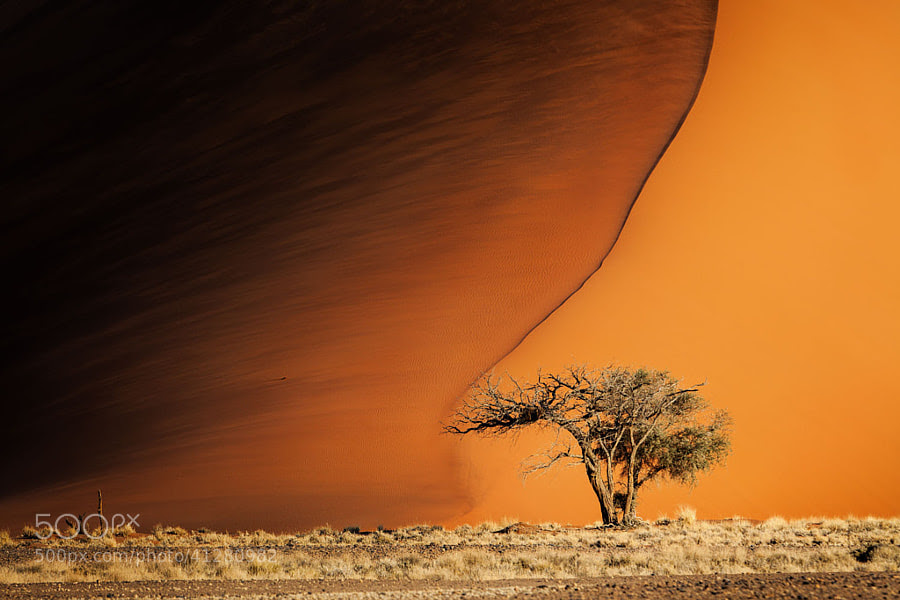
Sand Dune, Namibia

Minimalism by Marina Sorokina on 500px
This massive dune in the Namib Desert blocks light to one side of the slope, showcasing a stark contrast in an often unchanging desert landscape.
Skeleton Coast, Namibia
namibia ocean
On the west coast of Africa, the desert and its dunes run right up to the Atlantic Ocean. (Photo: David Yarrow Photography via Getty Images)
Grand Prismatic Spring, Wyoming

Grand Prismatic Spring by Max Waugh on 500px
The bacteria and microbial mats that thrive in this naturally heated pool change colors depending on the temperature of the waters.
Abraham Lake, Alberta, Canada


Frozen ice bubbles are seen trapped beneath the surface of a lake.
Ice Cave, Washington State

An Icy Adventure by Michael Matti on 500px
Melting and refreezing has created an alien-like texture on the ceiling of this cave.
Lake Baikal, Russia

Baikal ice by Daniel Korzhonov on 500px
Thick cracks are seen in the ice of Lake Baikal, the deepest and largest freshwater lake in the world in terms of volume. The lake plummets to nearly a mile deep in one of its basins.
The Wave, Arizona

   
This iconic sandstone rock formation is the result of millions of years of erosion by water and now primarily wind.
Bryce Canyon, Utah

Bryce (Canyon) at Sunrise by N Lester Ellorin on 500px
These jagged red rocks form the spectacular Bryce Canyon amphitheaters. The widely varying topography was formed by weathering and erosion of less resilient sedimentary layers.
Canyonlands National Park, Utah

Millions years of erosion have carved a wide variety of gorgeous features into this vibrant landscape.
Chocolate Hills, Philippines
135558476
More than 1,700 of these grass-topped limestone hills may dot the Bohol Province in the Philippines, millions of years after being weathered by erosion. The domes range in size from around 100 feet to 160 feet tall. (Photo: Per-Andre Hoffmann via Getty Images)
The Pinnacles, Australia
148433097
These ominous limestone formations are a big draw in Western Australia. While science has come to an agreement that they are made of the remnants of sea life at the bottom of what was once a vast ocean, there are some conflicting theories about why these specific spires are so far above ground. (Photo: Richard I'Anson via Getty Images)
Zhangjiajie, China

The renowned pillars in Hunan Zhangjiajie National Forest Park are the subject of both Chinese art and Western cinematography. The spires served as an inspiration for the alien world in the blockbuster film "Avatar."
Nubra Valley, India

This desert-scape high on the Tibetan Plateau is home to some of the most stunning slopes you'll find on Earth.
Tsingy de Bemaraha National Park, Madagascar
tsingy
Erosion has carved the land on this part of the African island into a remarkable stone forest. Much of the wildlife found in this area lives nowhere else in the world. (Photo: Haja Rasambainarivo via Getty Images)
Mono Lake, California

Dusk III by Mark Cote on 500px
With no access to freshwater, the water in this shallow lake is highly salty and alkaline, a result of the erosion of minerals that make up the surrounding geologic layers. Beginning in the middle of the 20th century, Los Angeles began diverting water from Mono Lake for use. It drained much of the lake's waters, exposing the now-iconic tufa towers seen in the photo above.
Mount Nyiragongo Volcano, Congo

lava lake by Francesco  Pandolfo on 500px
At least 34 eruptions have been recorded at this highly active volcano since 1882. It contains the largest known lava lake in the world.
Lava Flow, Hawaii
165513387
Molten lava from the Kilauea Volcano streams toward the ocean. (Photo: G. Brad Lewis via Getty Images)
Volcano, Iceland

Volcano in Iceland a projection in the river by Andre Ermolaev on 500px
Runoff from a volcano flows down a bed and into the water.
Er Wang Dong Cave, China

This enormous cave in central China is so large that it houses its own weather system -- meaning clouds and rain can appear below ground.
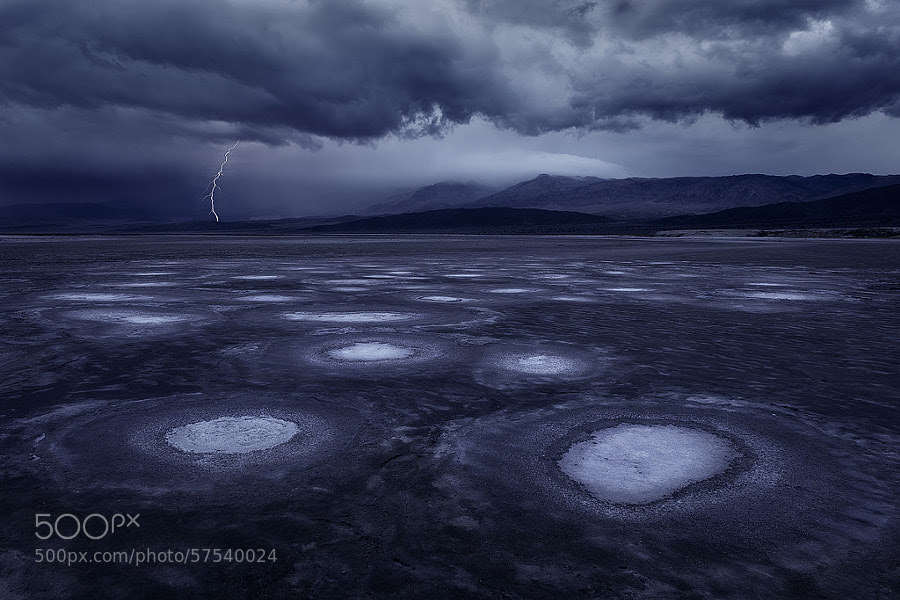
Death Valley, California

Something Wicked This Way Comes by Miles Morgan on 500px
A storm moves in over the salt flats in barren California.
Uyuni Salt Flats, Bolivia
The Salar de Uyuni are the largest salt flats in the world. The near-uniform topography makes for amazing sight-lines and great photo-ops.
More Uyuni Salt Flats
10193762
Though photographers don't always use human subjects. (Photo: Art Wolfe via Getty Images)
Dallol Volcano, Ethiopia

Ethiopia... volcano Dalol. by Victoria Rogotneva on 500px
At 150 feet below sea level, this is the lowest known volcano on land. Acidic discharge from the geologic activity has bleached the land in all sorts of extreme colors.
A Closeup Of Dallol Deposits

Round 50 years ago, a mining settlement of the same name was occupied just a few miles from this harsh terrain in Ethiopia.                                                      It was abandoned in the 1960s, though holds records for being one of the hottest continuously inhabited places on Earth.
The Richat Structure, Mauritania
The Richat Structure.  A circular feature in the Sahara desert that is ~30 miles wide.  Not an impact crater nor a volcano.
This enigmatic geological feature in the heart of the Sahara desert (seen here from space) has been the subject of much debate among scientists. Once thought to be an impact crater, geologists now consider it to be a deeply collapsed dome that was initially formed around 100 million years ago.

Wednesday, June 11, 2014

ReBorn by Manoj Maurya, Exhibition opened at nehruc centre Art Gallery on 10th June 2014

Lights, Action & Art

Displaying ReBORN_Painting_Exhibition_by_Manoj_Maurya_12.JPG
Last evening saw the inauguration of a unique painting exhibition that encompassed all the elements of art- paintings, music and films. The exhibition titled ReBORN by Manoj Maurya was open to public amidst colorful inauguration, music launch and screening of the film on ReBORN at Nehru Centre Art Gallery. When asked about the reason for blending music and film with paintings, artist Manoj Maurya said that I want to connect masses with visual arts and paintings. Music and Films as forms of art easily assimilate within the masses and provide them an opportunity to connect easily to art. Speaking about ReBORN paintings, Manoj says, “The philosophy of ReBORN has chosen me to decipher its essence to the world through my art. Each painting unfolds secrets of this universal truth.”

Displaying ReBORN_Painting_Exhibition_by_Manoj_Maurya_9.JPG


The guests present at the gallery were absorbed discovering their interpretations of paintings and interacting with Manoj to decode his thoughts behind the paintings. Dolly Thakore, renowned Indian theatre actress feels, “The evolving of the paintings and their mindset represent highly intellectual strings and a new interactive style of art.” Veteran Actor Suren Rajan who is known for his performances in The Legend of Bhagat Singh (2002), Phas Gaye Re Obama (2010) and Munnabhai M.B.B.S. (2003) was thoroughly enthralled with the paintings and found them deeply intriguing and thought provoking.
The Painting Exhibition is on till 16th June, 2014 at Nehru Centre Art Gallery, Mumbai.

Displaying ReBORN_Painting_Exhibition_by_Manoj_Maurya_1.JPG


A series of paintings on ReBORN has been created by Manoj Maurya, artist and thinker which is decoding this universal truth through the language of visuals.


Displaying ReBORN_Painting_Exhibition_by_Manoj_Maurya_2.JPG


As an artist, Manoj Maurya has been forerunner in elevating the essence of painting from being just a form of expression to a more encompassing form of mass participation. He firmly believes that art should engage the audience, interact with them and be more instrumental for the society rather than limiting to just artists' self expressions.

Displaying ReBORN_Painting_Exhibition_by_Manoj_Maurya_3.JPG

Through his painting exhibition ReBORN, Manoj wants to create a spiritual revolution within each one of us which will bring us closer to our inner strength and help us find solutions to the perpetual questions facing us. Manoj feels ReBORN is the answer to the crisis, the world is facing. http://www.manojmaurya.com/Home.html
Manoj firmly believes that painting as an art form should increase its reach and penetration within the society and involve general masses alike.http://www.manojmaurya.com/Common_Myths_Related_to_Paintings-Myth%202.html. He is actively involved in the task of creating appreciation of arts and aesthetics within audiences who do not have formal art background. He finds Music as the most easily assimilated form of art within the masses. Hence, he has spearheaded ReBORN music album to increase masses’ connectivity with visual arts.

Displaying ReBORN_Painting_Exhibition_by_Manoj_Maurya_6.JPG

As an effort to reach out to masses, ReBORN painting exhibition is reaching to every sector of the society. During the exhibition, we are having special screening organized for Blind people, AutoRickshaw Drivers & underprivileged children belonging to Asha Kiran NGOs. Through ReBORN, we want social inclusion of all sections of the society within the art & cultural scene & raise the creative quotient of the society.

Displaying ReBORN_Painting_Exhibition_by_Manoj_Maurya_14.JPG

Tuesday, March 11, 2014

Monday, February 17, 2014

Performance in Kolkata on Feb 22nd: This Side of the Truth - A Piece for a Flute and Hat

After an acclaimed premiere at the Pukaar festival in Pune, The Arshinagar Project presents 'This Side of the Truth - A Piece for a Flute and a Hat' in Kolkata on February 22nd.

This Side of the Truth - A Piece for a Flute and a Hat is a landscape of sounds and images, based on fragments of Dylan Thomas' poetry. It is a sort of poem of and in space, reaching simultaneously out to the shadows of our own past and future selves. Drawing upon a process of rigorous research on the organic connections between breath, musicality, body and text, the piece excavates the surface of Thomas' wordscapes, to create a montage of fragmentary, non-linear images, where the shadows of the man crash into the ghosts of the father and the son, skittering off each other across time and memory. 

The piece is devised and performed by Arka Mukhopadhyay and musician Pradip (Bula) Chaterji.

Date: 22/02/2014   Time: 7:30 PM
Contribution: 150/-  
Inline images 1

Wednesday, February 12, 2014

Call for Applications: Museum Fellowship, Deadline March 10, 2014

Tue Feb 11, 2014 4:12 am (PST) . Posted by:

"India Foundation for the Arts"


India Foundation for the Arts in Collaboration with the
Munshi Aziz Bhat Museum of Central Asian and Kargil Trade Artefacts
&
Inlaks India Foundation
invites applications for its
Museum Fellowship
Application deadline: March 10,2014

India Foundation for the Arts (IFA) in collaboration with the Munshi Aziz Bhat Museum of Central Asian and Kargil Trade Artefacts invites applications for its Museum Fellowship, an initiative to support curators to explore innovative ways of presenting museum collections, from a contemporary context. The Fellowship will give curators the opportunity to engage with the historical collection at the ethnographic museum in Kargil, re-present the collection and experiment with different forms of visualisation and design, related to the museum/exhibition space.  
Kargil used to be an important nodal centre for trade on the Silk Route in the 18th and 19th centuries and the museum has a varied collection of artifacts, mercantile items and Silk Route memorabilia. The intention of this Fellowship is to use this collection as a starting point to reflect on the complex history of the Silk Route, through constructing narratives around the objects, texts and legacies of the people who traversed these regions. The exhibition that will evolve from this Fellowship will be open to the public at the Kargil museum in August 2014.
The Museum Fellowship has been initiated with the two-fold objective of energising the museum and alternative audience spaces and providing curators with an opportunity to generate new critical and creative approaches to public engagement.
This Museum Fellowship is supported by the Inlaks India Foundation.
About the Museum
The Kargil Trade Artefacts museum located in Kargil (Ladakh), 204 kms from Srinagar, was established by the Munshi brothers, Gulzar and Ajaz, in 2004. The museum operates with the objective of preserving and promoting the rich heritage of Kargil in the context of the Silk Route. The museum’s collection includes textiles, manuscripts & books, utensils & crockery, pipes, jewellery, imported liquor price lists and horse accessories bought and sold along the Silk Route, from Turkey to China via Afghanistan in the 18th and 19th centuries.
This collection offers interesting and varied material for the curator to re-visit, re-examine, and re-present from a contemporary context. The museum also hosts a library and an archive.For more information about the background and history of the museum, please see their website, wiki page and video.
About the Fellowship
The Fellowship provides a monthly honorarium of Rs 30,000 for four months, and research and travel allowances up to Rs 60,000. Modest accommodation and a work space will also be provided by the museum for the duration of the Fellowship.
The Fellowship will be awarded for a duration of four months, commencing April 15, 2014. The exhibition will open in August, 2014.
Applicant Profile
We seek applications from curators, artists, art historians/researchers with previous curatorial experience, and with a strong interest in museums. We encourage applications from curators who can identify in the museum collection, a match between material history and storytelling.
Persons who are Indian nationals or have been a resident of India for five or more years are eligible to apply.
The deadline for receiving applications is March 10, 2014. Shortlisted candidates will be informed by March 17, 2014. Interviews are expected to take place at the end of March. The Fellowship start date is scheduled for April 15, 2014.  
Application Process
Your application must include:

A letter of interest explaining how you would benefit from this Museum Fellowship. Please ensure that you identify an aspect of your curatorial practice that you are interested in further developing during the course of the Fellowship;
A brief description of the curatorial approach of  a project you have been involved with in the past, either as curator or as researcher/assistant curator;
Your  curriculum vitae;
Documentation of your previous curatorial work, which could include photos/ jpegs (6-8 images) with titles and date, DVD (max 4 minutes), catalogues, or reviews.

Please address any queries to suman@indiaifa.org
T:(0)80 23414681/82
Please post the required documents to IFA in an envelope marked ‘Kargil Museum Fellowship’ by March 10, 2014.
Kargil Museum Fellowship
India Foundation for the Arts
'Apurva', Ground Floor, No 259
4th Cross, RMV 2nd Stage, 2nd Block
Bangalore - 560 094, India

Wednesday, February 5, 2014

Art in Public Spaces/Asia Society Talk Rajeev Sethi, Chairman & Founder Trustee, The Asian Heritage Foundation Dr. Vishakha Desai, President Emerita, Asia Society

Asia Society
Art in Public Spaces

With the growing prominence of arts awareness in India and an increasing call for civic responsibility in metropolises around the world, the role and position of public art has been brought to the mainstream with renewed force. The attention received by the recent opening of the public art programme at Mumbai International Airport’s Terminal 2 exemplifies art that has been incorporated by design into a public space. Our speakers will consider the potential engagement between traditional art establishments, such as museums, galleries, and educational institutions, versus the public art medium, and how this changing dynamic offers a new way to think about India’s artistic culture and heritage.  
 

Rajeev Sethi is one of South Asia’s leading designers and is noted internationally for his innovative contribution to preserving and celebrating the subcontinent’s rich cultural heritage. For more than 35 years, through his work in architecture, performances, festivals, and publication, he has identified ways to bring contemporary relevance to traditional skills of artisan communities and creative professionals.  Sethi has designed and curated award-winning exhibitions and events in Asia, Europe, Canada and America, for the United Nations and various international institutions.  Among his on-going projects are directing the Art Programme for the new Terminal 2 at the Mumbai International Airport and the Hyatt Chennai Art Collection. Sethi was awarded theSanskriti Award for outstanding social and cultural achievement in 1980, the Padma Bhushan in 1985 and the first Indira Gandhi Life Time Achievement Award for conservation by INTACH in 2010.


Dr. Vishakha Desai is President Emerita of Asia Society and an Independent Director at Mahindra & Mahindra. She serves as Special Advisor for Global Affairs to the President of Columbia University and is a Professor at the Columbia School of International and Public Affairs. She previously served as Asia Society's Senior Vice President of Museum and Cultural Programmes, President of the Association of Art Museum Directors, and Head of Public Programmes and Academic Affairs at the Museum of Fine Arts Boston. She is widely recognised as a leader in the museum field for developing dynamic presentations of contemporary works by Asian and Asian American artists and for conceiving innovative exhibitions of traditional Asian art within strong cultural contexts. Dr. Desai has also taught at the University of Massachusetts, Boston University and Williams College.

Image above: Rajeev Sethi & Vishakha Desai

Speakers
Rajeev Sethi, Chairman & Founder Trustee, The Asian Heritage Foundation
Dr. Vishakha Desai, President Emerita, Asia Society
 

Date: Thursday, 13th February, 2014

Time: 6:30pm, registration begins at 6:00pm

Venue: National Gallery of Modern Art Auditorium, Mumbai

RSVP required: 
asiasociety@asiasociety.org.in
Priority for Asia Society Members

In Partnership with


This programme is in partnership with the NGMA Mumbai, and a concluding celebration of the “Across Oceans and Flowing Silks from Canton to Bombay 18th-20thCenturies” and “No Parsi is an Island” exhibitions.

Outreach partners:

This programme is part of ourAsiaLens series, which presents an array of perspectives on the visual and performing arts of modern Asia, offering a vibrant and nuanced view across the continent. Previous events under this series include a Behind-the-Scenes Tour of the CSMVS Conservation Centre with Anupam Sah, a lecture with Dr. Sugata Bose on the paintings of Rabindranath Tagore andCommerce and Culture from Canton to Bombay.